
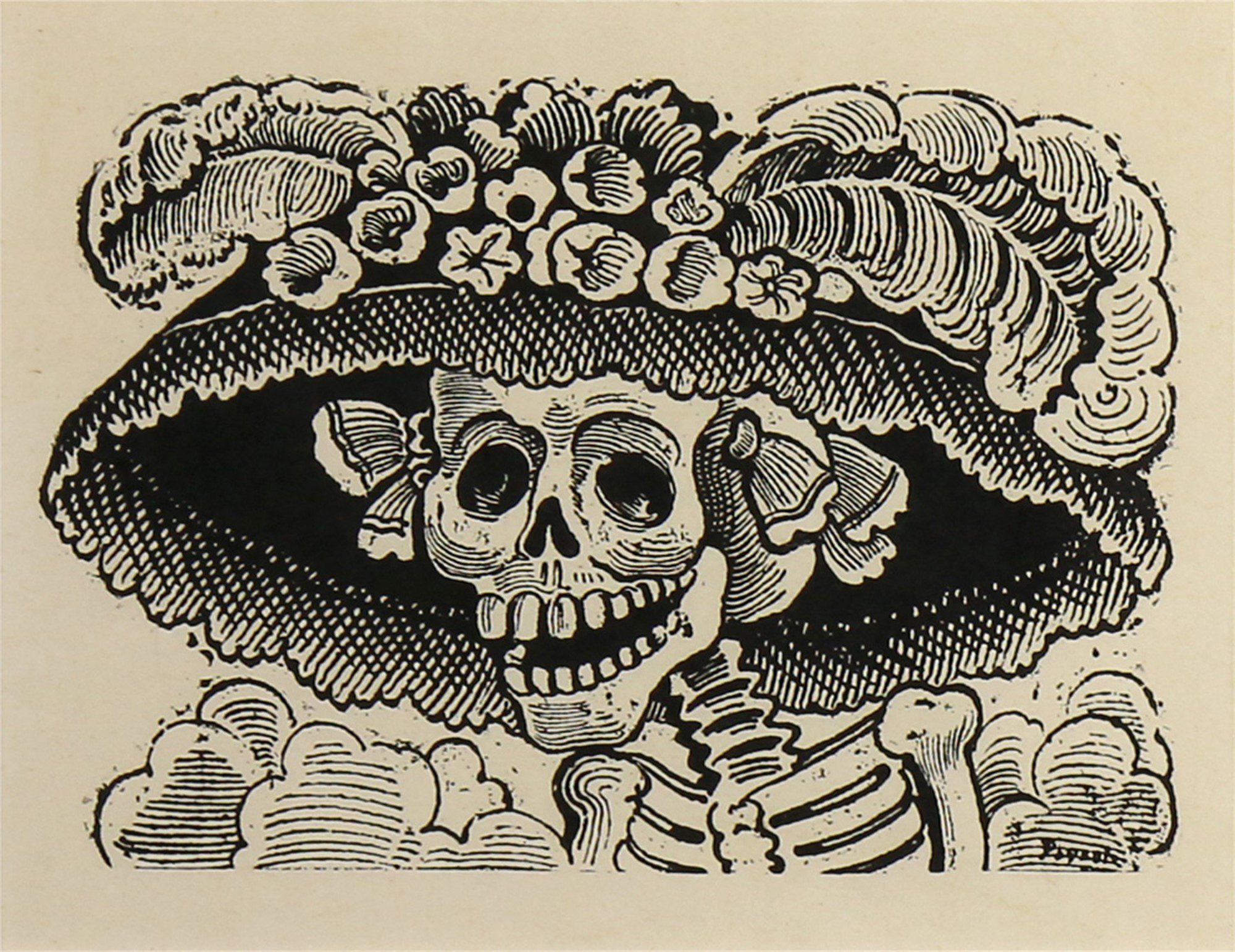
Day of the Dead’s Jose Guadalupe Posada and La Catrina with Jose Gabo Art of Austin Texas

Author: rayela
Brazil 18years + Chicago 20yrs + Paducah since 2005 These have shaped my path and interests. I spent many years as an active artist (ceramics and textiles) but have focused on promoting the creative community online since 2010. My current projects are Artizan Made and this site, Creative PlaceMakers.

I think the Day of the Dead is my favorite Holiday ever! It’s rooted in various Indigenous and European traditions, celebrated on November 2nd with All Saints’ Day when those who have passed before us are honored and remembered. The Mexican version, Dia de Los Muertos, has grown into a splendid ritual of color, food, parades, costumes and dance! La Catrina, a fancy skeleton with a huge hat, embodies these festivities as a symbol that merges political satire with indigenous honor. The clay figures above are from Its Cactus, one of our Artizan Made members who works with artisans all over South and Central America. Click on the photo and you will go to their website where there are other variations of La Catrina available for purchase. I have a similar one to these that I bought in Mexico over thirty years ago and love it!
Jose Guadalupe Posada created La Catrina in 1913 as a criticism of wealthy women who pranced around in their fancy clothes, imitating European fashion while disparaging their Mexican roots. Diego Rivera gave her extra meaning and importance by making her the focal point of one his murals. The Mexican Folk Art Guide states:
“In Rivera’s mural, La Catrina stands arm-in-arm with Posada himself, while young Diego appears holding her hand.
The figure bridges the old and new Mexico, symbolizing the end of the Porfirian era and the beginning of a modern, more egalitarian nation after the Revolution. … Through Rivera’s interpretation, La Catrina became not only a character but a cultural symbol: death personified with grace and dignity. She reminded Mexicans that death is not to be feared, but faced with style and humor.”

This video gives a short overview of Posada’s life. It’s only about 3 minutes long…
Posada’s etchings inspired Mexican artists who went on to create a distinctive genre of folk art that is immediately recognizable as Day of the Dead centered while universal in messaging about everyday life. Most of it tends to have some humor, but many continue to follow Posada’s lead in using the skeletons as political commentary. Sadly, Posada died in poverty and never saw how much he influenced Mexican culture and identity.
What I love about his work and how the Day of the Dead is celebrated centers on the idea that all of us are the same after we die, just some bones. There is no racism, no idea of beauty, but the accessories and behavior of the skeletons give some ideas about what was important to them. I also love other Day of the Dead traditions, honoring the dead with altars that embody stories about those being remembered: photos, their favorite foods and drinks, meaningful objects…. When I lived in Chicago, the National Museum of Mexican Art had wonderful Day of the Dead celebrations. An especially moving one for me highlighted the loss our community suffered from gang violence. The altars celebrated lives that were cut short, often at a young age. Very sad, but beautiful to be remembered like that….
Halloween has the same roots on the European side of history, but has evolved into such a violent and bloody culture that it repels me. I did write a post on our sister site, Artizan Made, about costumes that looks at historical photos from both Halloween and the Day of the Dead. Fun!
 Halloween or Day of the Dead? Costumes from the past.
The visual and sensory impact of the Day of the Dead in Mexico transforms the every day life into a blast of color, music and dance! Here are a few videos I found on Instagram that give you and idea of the celebration, especially in Oaxaca. La Catrina shows up often!
View this post on Instagram
View this post on Instagram
View this post on Instagram
View this post on Instagram
View this post on Instagram
View this post on Instagram
As you can see in the last video, the Day of the Dead, Mexican style, has spread to the diaspora abroad, inspiring artists with new interpretations of what a skeleton might have to say. Jose Gabriel Lopez of JoseGaboArt was born in Mexico but lived in Chicago for many years and has since been in Austin, Texas, working as a teacher and prolific artist. The skeleton has been a recurring theme in his work, often with a humorous bend, but also as a desolate prophet of the corruption and attacks on nature that we see all around us.

Jose works mostly with oils on canvas, although he has also made wonderful paper mache pieces and jewelry.

His skeletons have evolved over the years and he now has his own version. Lately he has been animating some of his paintings, a fun way to tell the stories behind them! This one has to do with the skeleton carrying his soul. I was unable to make the preview show up so if you can’t see it, just click and you will see the video.
La Catrina has showed up in his work, too. This is a Patreon sketch showing the connection with Diego Rivera and Frida Kahlo.

La Catrina also shows up in his Etsy shop, on a t-shirt:

Visit Jose’s website and explore his work. Some of it is the stuff of nightmares while the rest of it is tender and funny.
Jose is a member of our sister site, Artizan Made. Learn more about him on his profile.

This story is an example of how one man’s creativity, Jose Guadalupe Posada’s, impacted a whole culture with his work. While he died a poor man, his work went on to spur millions in economic development in Mexico and abroad. The creative spirit that lived in Posada and inspires JoseGaboArt can never be replicated by AI which only sucks up what has already been done and regurgitates it into a shadow of the original. La Catrina, originally created as an insult by Posada went on to stardom through Diego Rivera.
Andrew Colón has a wonderful YouTube channel, @MysteriesoftheAmericas, loaded with fascinating research on Latin American history and culture. His video on La Catrina pulls together all of these threads of Posada, Rivera, background history, how the Day of the Dead took off as a major holiday and captured the imagination of the world, the political angles along the way and mass marketing that actually created a full circle back to Posada’s criticism of the elite versus the poor of his day. This is truly worth a watch!
In the end, Posada’s spirit of defiance lives on through artists who use La Catrina as a message to our current elite. La Muerte Maria embodies La Catrina as protest:
We all come here with a dream—just like Dr. King said, “I have a dream.”
Mine isn’t defined by color, borders, or barriers—it’s about dignity, opportunity, and hope.
No matter where we come from, we carry that same fire inside us.
A dream to live free, to be seen, to belong.Artist/ Designer/ Makeup @lamuertemaria
Models @nancysg1993 @nonfiltered76
View this post on Instagram
Creative PlaceMakers seeks to map creatives who stand up for social justice and the environment. The goal is to show that we are not alone, that we thrive around the world and that together, we can create a visual presence that inspires and supports. Join us! Membership is only $25/year. Each member shows up in six categories, each with their own map. New connections and inspiration will happen as we grow.
How to join: https://creativeplacemakers.net/get-listed/
Member Directory: https://creativeplacemakers.net/member-directory/
If you sell handmade products online, join our sister site, Artizan Made.
Cultural Map
Members who selected “Cultural and Historical” as a category show up here.




Discover more from Creative PlaceMakers
Subscribe to get the latest posts sent to your email.