
Immigration: Sanctuary in Tasmania – Rita Summers Art Quilt

Author: Rita Summers
Rita creates her work from the land itself – leaves and – the result of a direct relationship and collaboration with the Tasmanian landscape. She finds and reinvents vintage and recycled materials with natural dyes or earth paints combined with contemporary stitching techniques, allowing the materials themselves to inspire her creations. Through workshops, exhibitions and her videos, Rita’s passion is to inspire and encourage others to develop confidence in their own unique artistic expression.
Rita Summers is a Creative PlaceMakers member and a member of our sister site, Artizan Made. She uses botanical dyes to mark upcycled fabrics and garments which she sells on her website, Gone Rustic. Rita shares her process and projects freely on her social media sites and has a wonderful series on YouTube. Her husband, Ian, is also a talented creative, playing music and building things. They recently finished their new home where Rita has plenty of foraging materials for her dye and mixed media projects.


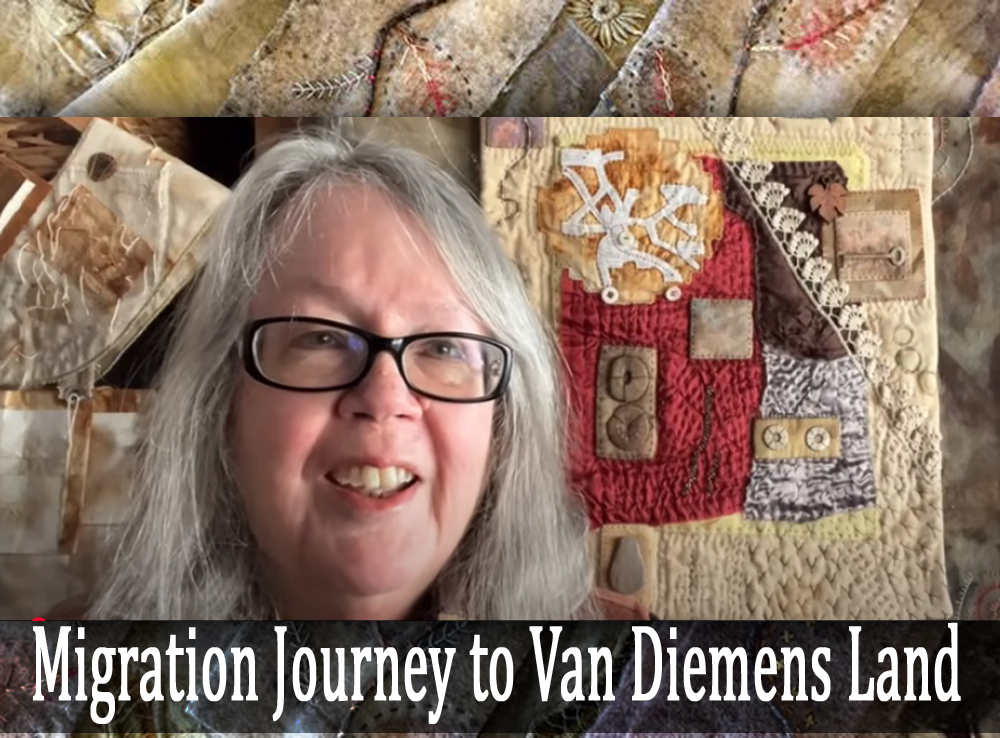
Much of Rita’s work has deep meaning for her, exploring memory, social issues, and the natural world. She created an art quilt that embodies the journeys that brought both Rita and Ian to this wonderful home in Tasmania. Rita has used many different textile forms to tell these stories: books, scrolls, art quilts and 3 dimensional works. This one is especially moving. The video’s transcript follows at the end of the post.
This art quilt symbolises my husband’s and my shared migrant history. Ian’s forbears arrived in Tasmania from Prussia, Germany, the UK and Ireland (1804-1853), and my parents from the Netherlands via Canada (where I was born).

I originally stitched a real feather at lower left, but it got damaged so I embroidered one instead.

A number of items are trapped under vintage chiffon or sewn on top, including photographs and found objects; I made the crochet lace years ago.


Vintage or upcycled fabrics, including tea-dyed cotton (front) and indigo-dyed shibori linen (back) which was very fragile and had to be patched. I chose to face the edges onto the back instead of binding in the usual way.
Entirely hand-stitched. [Begun in a Diane Savona workshop and finished years later.]
Size: 50 cm x 70 cm
video transcript
This quilt took me a number of years to produce or to complete. I started it in a workshop with Diane Savona. I think that’s how you pronounce it. She’s an American textile artist. I went to a workshop in Hobart with her and this is where it began, but I didn’t actually finish it until last year. The trigger for sharing this with you today is because a friend gave me a newspaper article from 2009 when my dad was featured in a full page spread in the LCS examiner. That’s Launceston, Tasmania.
I thought I’d share a little bit about that with you. This little quilt actually represents both sides of our family, my husband’s and my side because there is a migratory story on both sides. Some in the 1800s and maybe earlier and some only in the 20th century which includes me of course and my parents. So, thank you for joining me and I hope you enjoy what I’ve got to offer you today.
This is the newspaper article that I was talking about and I remember when it was published. My Dad did tell me about it because he was still alive then. Mom had already passed away by this stage. So he was on his own and I know that was a bit of a struggle for him at times but he was also a very positive person and when you look at his life it was really not an easy life that he had. He was just a really lovely man and I was very honored to have him as my Dad. He wasn’t perfect, of course. None of us are, but he made a good life for himself and his wife, my Mom, and his six children, of which I’m the eldest.
This article is called Sanctuary in Tasmania. Peace found in horticulture. Just above that, Dad was a qualified horticulturist and in the Netherlands. He qualified or partially qualified before the war. Then the war broke out and he had to put it on hold. He’d only just started his studies I think in his mid- teens and he ended up volunteering for the Dutch Resistance Movement, one of the organizations in the north of the Netherlands.
I’ve done a bit of research on this and his family was quite involved. His two aunts were secretaries in this underground group. The printer that printed anti-Nazi propaganda was right next door to his grandfather’s wine business. They made wine and I have some labels actually from the wine of that business. So they were quite deeply involved. Dad was quite young. He was only 16 or 17. So he was a courier and one of the things they did was they sheltered airmen who crash landed in the Netherlands behind enemy lines, gave them a sanctuary, fed them up and looked after them and then smuggled them out.
He had a couple of very narrow escapes. He was just this young lad on his bicycle delivering messages… There are some photos of him as he was growing up. This one shows him with his foster mother. (3:54 on video)
His mother died shortly after he was born. His father wasn’t able to look after the children, so they were all farmed out. All the girls were farmed out to family, but the boys were put in an orphanage. My dad grew up in an orphanage. He never really knew what it was like to have a home.
Fortunately, his family, his extended family, tried to keep in touch with him and gave him holidays during school holidays and when he was working and also when he was in the army later on. He would stay with different aunts and uncles and so on for weekends. I think they did the best they could in the situation they were in.
Of course, the war didn’t help matters very much at all either. One of the things that came out of the war was that Dad got to know my Mom. There she is. A lovely photo of her from 1947. (4:44 on video)
She was actually part of the movement to write to the soldiers on the front to encourage them. And so she was writing to a few soldiers in her brother’s platoon. His name was John also and so was my Dad, Jan, in Dutch. Her brother said to Dad, “You know, you don’t seem to have much contact with your family. Would you like my sister to write to you? So he said yes, that would be lovely. And after they’d written for a little while, he asked her not to write to the other guys and she stopped writing to them and only wrote to him.
Well, as you can guess, what happened next was that once the war was over and he was back in the Netherlands, they got engaged and then they got married and they immigrated to Canada. I was born in Canada as were all my siblings. And then in the 1960s, we had a visit from my aunt and uncle who had immigrated to Tasmania in Australia. I remember their visit. It was lovely getting to know them. We didn’t have any relatives much in Canada. We had one of mom’s cousins. I think that was it. The rest were all in the Netherlands apart from this aunt and uncle. My uncle had a business, quite a good business, and he said if you ever decide to come to Tasmania, I’ll give you a job until you find what you would like.
Ultimately, they did that. Dad couldn’t work as a horticulturist in Canada or in the beginning, in Tasmania. In Canada, the weather was just too cold in the winter and the summers were too short. In Tasmania he had to do whatever he could get because he had six children to feed and anyway, ultimately he did end up doing horticulture and when he retired, it was really a happy time for him.
That’s just a potted history of my family. There’s a so much more I could tell you. I’ve written articles about both my husband’s and my family history. My parents migrated twice and I think that must be a little bit unusual from the Netherlands to Canada and then probably about 14 or 15 years later to Tasmania with a big family.
I’ve got the migration quilt here. (7:07 on video) Here we have a map of the area that I’m living in now because this is where I’ve ended up and the stitch lines show where we’ve lived during our time in St. Mary’s.
I’ve done other things which are fairly symbolic, but I’ve also trapped things like photographs in the layers underneath some naturally dyed or rusted silk and found objects and lots of stitching, including a feather which I’ll just hold up here. I did actually have a real feather there initially, but it disintegrated. So, I’ve actually stitched a feather using that feather as my pattern. The reason that is there is because one of my husband’s family surnames, which comes from Prussia, is something to do with “hawk”. That’s why the feather is there. The other found objects are not necessarily significant. They’re just things that I’ve found or that were available in the workshop that I started this in. I just like the history of those found objects which you don’t always know but you can sense. They add to the whole story of this.
Here we have other found objects. (8:27 on video) Some old buttons, vintage buttons. … that’s actually rubber, I think, that I found on the road and a bit of metal and some I think they’re copper cable ties so they’re quite old. A key often appears on my work.
This is lace that I crocheted years ago and didn’t know what to do with and it found its place on here. I’ve done quite a bit of fly stitching because I think they look like bird footprints and I think that kind of hints at the the traveling migratory theme.
At the top and the bottom, I’ll just show you the one at the bottom. I’ve done stylized ship masks because Ian’s ancestors came on various ships and they came from all over the world or all over Europe, anyway from Prussia, Germany, England, Ireland and Scotland.
This is quite a significant work for me and it’s been in a few exhibitions. It’s now hanging up in our home.

Many thanks to Rita for sharing this story about her family, especially her parents, with us!
This is a part of our Immigration Series. Rita’s social media links are at the bottom right corner on her website: gonerustic.com
Do you have an immigration story to share about your family or someone you know? Join us and I’ll let you know what I need to get it up.
Feel free to leave questions or comments for Rita below! If you are on your phone, you have to scroll all the way down to see it.
Discover more from Creative PlaceMakers
Subscribe to get the latest posts sent to your email.